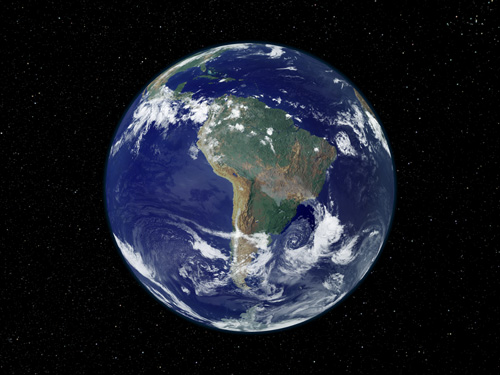
Photo credit: NASA
The first serious attempts to compute the age of the Earth were done by Lord Kelvin around 1840. Kelvin used Fourier’s law of heat, with the gradient of temperature measured empirically, and some very strong hypotheses simplifying the problem: there are no external sources of heat, and the planet is rigid and homogeneous. He gave an interval of 24 to 400 million years. It is now known that the age of the Earth is 4.5 billion years. Already at the time of Kelvin, his estimate was in contradiction with the observations of the geologists, and it was incompatible with the new theory of evolution of Darwin, which required a much older planet. It was Kelvin’s assistant, John Perry, who pointed out that the gradient of temperature was too large for Kelvin’s hypothesis of homogeneity, and that this gradient could be explained by convection movements inside a fluid under a thin outer solid mantle: these convections movements would slow down considerably the cooling of the mantle, and allow the age of the Earth to be over 2 billions years. Radioactivity, a source of heat, was soon after discovered, showing that energy could not be assumed to be constant. John Perry was visionary at his time: he was arguing that the mantle of the Earth is solid on short time scales, and fluid over longer time scales. But the idea of the continental drift met strong skepticism among the scientific community including the geologists, and it is only in the 1960s that it finally prevailed. (Reference: Kelvin, Perry and the Age of the Earth, P.C. England, P. Molnar and F.M. Richter, American Scientist, volume 95, 2007)