“Science without data is science-fiction”
This was on of the boldest (if more facetious…) statements heard at the workshop “Models and Methods in Ecology and Epidemiology (M2E2)” held at CRM last week. Speakers from very diverse backgrounds presented a wide rage of mathematical models developed to better understand the dynamics and propagation mechanisms of, amongst others, Avian Flu, Lyme Disease and the West Nile virus. Throughout the presentations, the pervasive role played by data incorporation in the models was emphasized, and the equally important organization of model development as a team effort was underlined. The contribution of, amongst others, entomologists, ecologists and public health officials in formulating the realistic details of the dynamical models was a recurring theme. The mechanisms of data acquisitions need to be examined, as bias and uncertainty can hardly ever be underestimated, and new technologies must be explored for data acquisition to enhance its reliability: equipping wild birds with individual satellite transmitters was seen to significantly enhance our understanding of migratory routes. A recent development is the incorporation of social behavior in some of the disease propagation models, with the expansion of social media providing significant challenges to understand these literally human aspects.
The scientific problems covered were broad, and the mathematical techniques employed equally comprehensive: finite-difference equations, differential equations as expected (some of the delayed variety, others in the more traditional PDE clothing), and the mathematical techniques employed, as well as the computing power required, equally broad: from essentially pencil-and-paper to supercomputing via GIS.
For those of us with some experience in mathematical modeling, this is far from surprising: it just re-emphasizes the global scheme involved, as illustrated below [1].
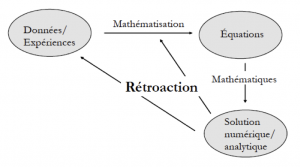
The analysis of the mathematical models, numerical of otherwise, is but a fraction of the process involved in bringing mathematics to bear on the solution of the challenging problems facing Planet Earth, in 2013 and for the foreseeable future.
Indeed, there is more to Life than proving theorems.
[1] J. Bélair, Chaos et complexité, modèles et métaphores: quelles leçons pour l’enseignement des mathématiques. In: Affronter la complexité: nouvel enjeu de l’enseignement des mathématiques, F. Caron (ed.), Proceedings of the Annual Meeting of the Québec Group of Mathematics Didacticians (2005), pp. 135-145.