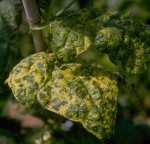
Photo Credit: Howard F. Schwartz, Bugwood.org
In terms of conservation and biodiversity, a significant number of invasion events around the world have been associated with the presence of pathogens. Invasion success depends on the increased relative fitness of the invader as compared to the native species. A classic example of this is the Barley/Cereal Yellow Dwarf Virus (B/CYDV), with its massive invasion of native perennial grasslands in western Oregon and California introduced by annual grasses. B/CYDV in the United States, African Cassava Mosaic Virus and others require a deeper study of plant physiology and epidemiology in crop models and economic models, as well as a better understanding of the effects of climate change and control measures to curtail economic losses.
Mathematical, statistical and computational methods can contribute to problems in vector transmission of plant viruses. Areas to focus on include the impact of climate change on plants, vectors and viral transmission, the environmental determinants of plant growth, temperature, timing and soil nutrients, the effect of plant genetics on viral persistence, vector dispersal and behavior on pathogen transmission and other facts such as co-infection on transmission.
The problems in vector transmission of plant viruses are multi-scale and highly dependent on environmental variables. Thus, multidisciplinary teams with expertise in biology and mathematics are needed to solve these problems.
In March, the National Institute for Mathematical and Biological Synthesis (NIMBioS) will host an Investigative Workshop on Vectored Plant Viruses, which will provide a forum for discussion of current problems on vectored transmission of plant viruses, with the goal of identifying mathematical, computational, and statistical methods, as well as insights derived using these methods.
This workshop will bring together experts in plant pathogens, agronomy, and vector and plant virology, physiology, and ecology with mathematical and statistical modelers to discuss problems in prevention and control of vector transmission of plant pathogens. It is expected that the workshop will lead to new collaborations and working groups on methods for prevention and control of vector transmission of plant viruses, which promote sustainable agricultural practices and reduce species invasions.
Co-organizing the workshop are Linda J. S. Allen (Mathematics and Statistics, Texas Tech Univ., Lubbock); Vrushali A. Bokil (Mathematics, Oregon State Univ., Corvallis); Elizabeth T. Borer (Ecology & Evolutionary Biology, Univ. of Minnesota, Minneapolis); Alison G. Power (Ecology & Evolutionary Biology, Cornell Univ., Ithaca, NY); and Frank Van Den Bosch (Computational and Systems Biology, Rothamsted Research, Hertfordshire, UK).
If you have an interest in these topics, the workshop is still accepting applications. The application deadline is Oct. 28, 2013. Individuals with a strong interest in the topic, including post-docs and graduate students, are encouraged to apply. Click here for more information and on-line registration.
NIMBioS Investigative Workshops focus on broad topics or a set of related topics, summarizing/synthesizing the state of the art and identifying future directions. Organizers and key invited researchers make up approximately one half the 30-40 participants in a workshop, and the remaining 15-20 participants are filled through open application from the scientific community. If needed, NIMBioS can provide support (travel, meals, lodging) for Workshop attendees.