Login

Mathematics of Planet Earth

  • Home
  • About MPE
  • Programs
    • Long Term Programs
    • Summer Schools
    • Workshops
    • Meetings
    • Special Sessions
    • Colloquia and Seminars
    • Public Lectures
    • Simons Lectures
  • Education
    • Public Lectures
    • Speakers Bureau
    • Summer Schools
    • Resources
    • Posters
    • Curriculum Materials
    • Academic programs
  • Events
    • MPE Day at UNESCO
    • Public Lectures
    • Exhibitions
    • Competitions
    • Awareness events
  • Partners
    • MPE2013 Partner Reports
    • Societies
    • International Bodies
    • Institutes
    • Research Centers
    • Scientific Journals
    • Teacher Associations
    • Academic
    • Magazines
    • Science Centers
    • Others
    • Becoming a Partner
  • Learn More
    • Books
    • Articles
    • Educational Resources
    • Videos and Podcasts
    • Speakers Bureau
  • Newsroom
  • Blog
  • Calendar
  • Opportunities
  • Français

Search

Latest Posts

AIM/MCRN Summer School: Week 6

August 2, 2020

 [...]

AIM/MCRN Summer School: Week 5

July 26, 2020

 [...]

Professor Christopher K.R.T. Jones — Recipient of the 2020 MPE Prize


Professor Chris Jones is the Bill Guthridge Distinguished Professor in Mathematics at the University of North Carolina at Chapel Hill and Director of the Mathematics and Climate Research Network (MCRN). The 2020 MPE Prize recognizes Professor Jones for his many significant contributions to climate science and the mathematics of planet Earth.

Categories

Chaos in the Solar System

Celestial Mechanics
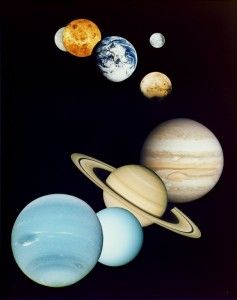
Photo Credit: Nasa

The motion of the inner planets (Mercury, Venus, Earth and Mars) is chaotic. Numerical evidence was given by Jacques Laskar, who showed in 1994 that the orbits of the inner planets exhibited resonances in some periodic motions. Because of the sensitivity to initial conditions, numerical errors grow exponentially, so it is impossible to control the positions of the planets over long periods of time (hundreds of millions of years) using the standard equations of planetary motion. Laskar derived an averaged system of equations and showed that the orbit of Mercury could at some time cross that of Venus.

Another way to study chaotic systems is to use numerous simulations in parallel, using an ensemble of initial conditions and derive probabilities of future behaviors. The shadowing lemma guarantees that a simulated trajectory for a close initial condition resembles a real trajectory. In 2009, Laskar announced in Nature the results of an ambitious program of 2000 parallel simulations of the solar system over periods of the order of 5 billions years. The new model of the solar system was much more sophisticated and included some relativistic effects. The simulations showed a 1% chance that Mercury could be destabilized and encounter a collision with the Sun or Venus. A much smaller number of simulations showed that all the inner planets could be destabilized, with a potential collision between the Earth and either Venus or Mars likely in approximately 3.3 billion years.

This entry was posted in Celestial Mechanics by MPEContributor. Bookmark the permalink.

Comments are closed.

  • Contact

IMU UNESCO ICIAM ICSU